


 By
By By Siphesihle Dlamini
The Phase II salary adjustments announced by the government are set to have a significant financial impact, costing approximately E230 million annually.
This revelation was made by Mthunzi Shabangu, Principal Secretary in the Ministry of Public Service, during a post-media briefing held at the Private and Cabinet Office.
This announcement comes on the heels of Prime Minister Russell Dlamini’s declaration that the government has successfully signed a collective agreement with the staff associations representing the Royal Eswatini Police Service (REPS) and His Majesty’s Correctional Services (HMCS).
The agreement, finalised a day before the announcement, aims to address longstanding salary discrepancies and enhance the financial well-being of security personnel.
During the briefing, PS Shabangu highlighted that over 952 security officers are set to benefit from professional adjustments. These adjustments will include an 8 per cent once off backpay, which alone is estimated to cost the government around E57 million per year.
This financial commitment reflects the government’s recognition of the essential roles played by these officers in maintaining public safety and order.
In addition to the professional adjustments, approximately 13,199 officers are eligible for a 3 per cent salary increment, which also includes once off backpay.
he estimated cost for this increment is around E171 million per year. When combined, these adjustments bring the total estimated budget for the salary exercise to E228 million annually.
Shabangu emphasised that this adjustment is not a standalone initiative; it does not exclude security officers from the ongoing salary review exercise currently being undertaken by the government. This broader review aims to ensure that all public service salaries are competitive and reflective of the current economic environment, further underscoring the government’s commitment to fair compensation for its employees.
Prime Minister Russell Dlamini announced a significant development regarding the remuneration of the country’s security services.
Key elements of the agreement involve aligning the remuneration for the ranks of Inspector/Chief Officer, Assistant Superintendent, and Superintendent, who will receive an 8 per cent retroactive one-time back pay for up to twenty-four (24) months.
Additionally, there will be a 3 per cent increase in the basic salary for functional officers holding ranks such as Assistant Inspector/Assistant Chief Officer, Sergeant Instructor, Sergeant, Warder Instructor, Constable, and Warder/Wardress, also with a maximum back pay of 24 months. The implementation of this agreement is set to take effect in September 2025.
The announcement, made during a press briefing on Thursday, revealed that the government has successfully reached and signed a collective agreement aimed at adjusting the professional ranks and salaries of various personnel within the security sector.
In his address, Prime Minister Dlamini stated, “On behalf of His Majesty’s Government, we would like to give an update on a matter that began as a restructuring exercise with the sole objective of aligning remuneration of similar ranks in the country’s security forces but turned into an issue of major national interest.”
This remark underscores the gravity of the negotiations, which have garnered widespread attention and discussion among the public.
The PM acknowledged the extensive dialogue that had taken place, noting, “This matter had become so popular that it became a long, involved historical and legendary story spoken of in both hushed and loud tones in various quarters of the land. This was not meant to be at the onset, but we blame no one.”
The collective agreement, signed on the evening before the press briefing, entails several key adjustments to the remuneration structure for security personnel.
Prime Minister Dlamini emphasised the importance of this agreement, stating, “Government and the Staff Associations have further agreed that this agreement shall be binding upon all parties and all members of the security forces and that it is in full and final settlement of all outstanding issues about the professional adjustments of salaries in the security forces (otherwise known as Phase II).”
This statement highlights the commitment of both parties to resolve the matter definitively and to uphold the terms of the agreement.
“We are pleased to announce that following several negotiation meetings facilitated by the Ministry of Public Service with the Staff Associations representing both the Royal Eswatini Police Service (REPS) and His Majesty’s Correctional Services (HMCS), a Collective Agreement has been signed to conclusively address this issue,” he stated.
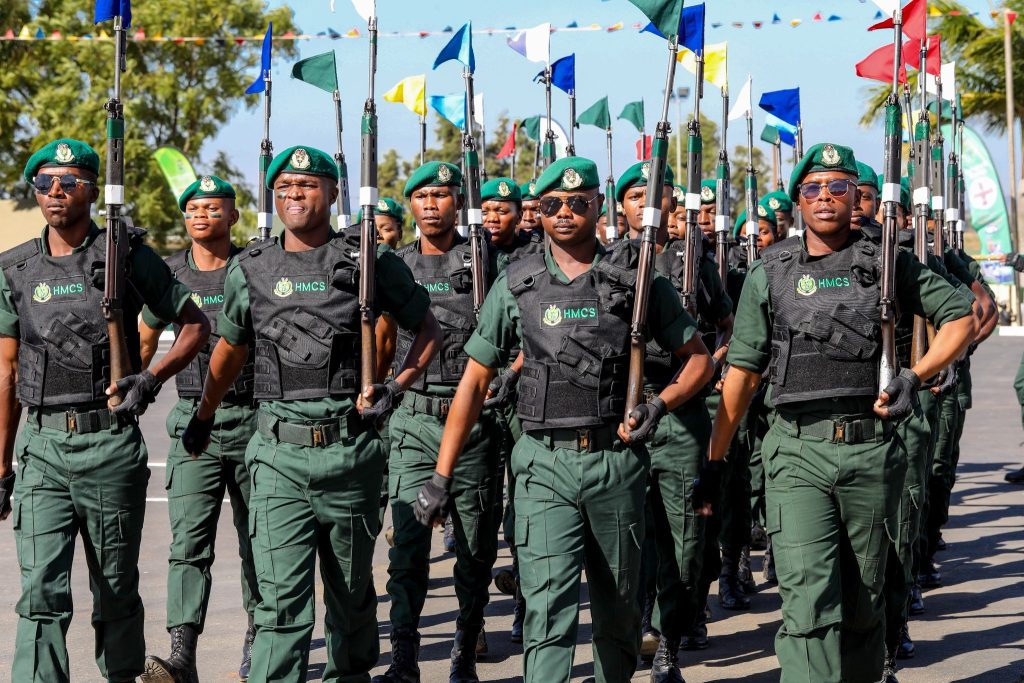
In this Agreement, guided by a consultant’s report and aiming for a definitive resolution, the parties have agreed on the following terms:
Professional Adjustment Levels
a) The Government will implement the recommended professional adjustments for the three ranks identified as misaligned in the Consultant’s assessment: Inspector/Chief Officer, Assistant Superintendent, and Superintendent.
b) The Government will apply these adjustments with a one-time retrospective back-pay at an 8% Net Present Value (NPV) rate for a maximum of twenty-four (24) months, followed by appropriate realignment.
c) The recommended professional adjustment for the rank of Assistant Inspector/Assistant Chief Officer will be implemented within the context of the functional levels below, given the minimal adjustments required for these ranks.
d) For Functional Levels (including Assistant Inspector/Assistant Chief Officer, Sergeant Instructor, Sergeant, Warder Instructor, Constable, and Warder/Wardress), the Government will provide a 3% increment on basic salary, backdated for a maximum of twenty-four (24) months. This increment will be limited strictly to functional officers who will not receive the professional adjustments mentioned in point a).
The premier expressed gratitude to those involved in the negotiations, stating, “We take this opportunity to applaud all those who have worked tirelessly to get us to this final settlement of this matter.” He further expressed hope that the resolution would be well-received by all officers and their families, reinforcing the government’s commitment to the well-being of its security forces.


