


 By
By 
By Delisa Magagula
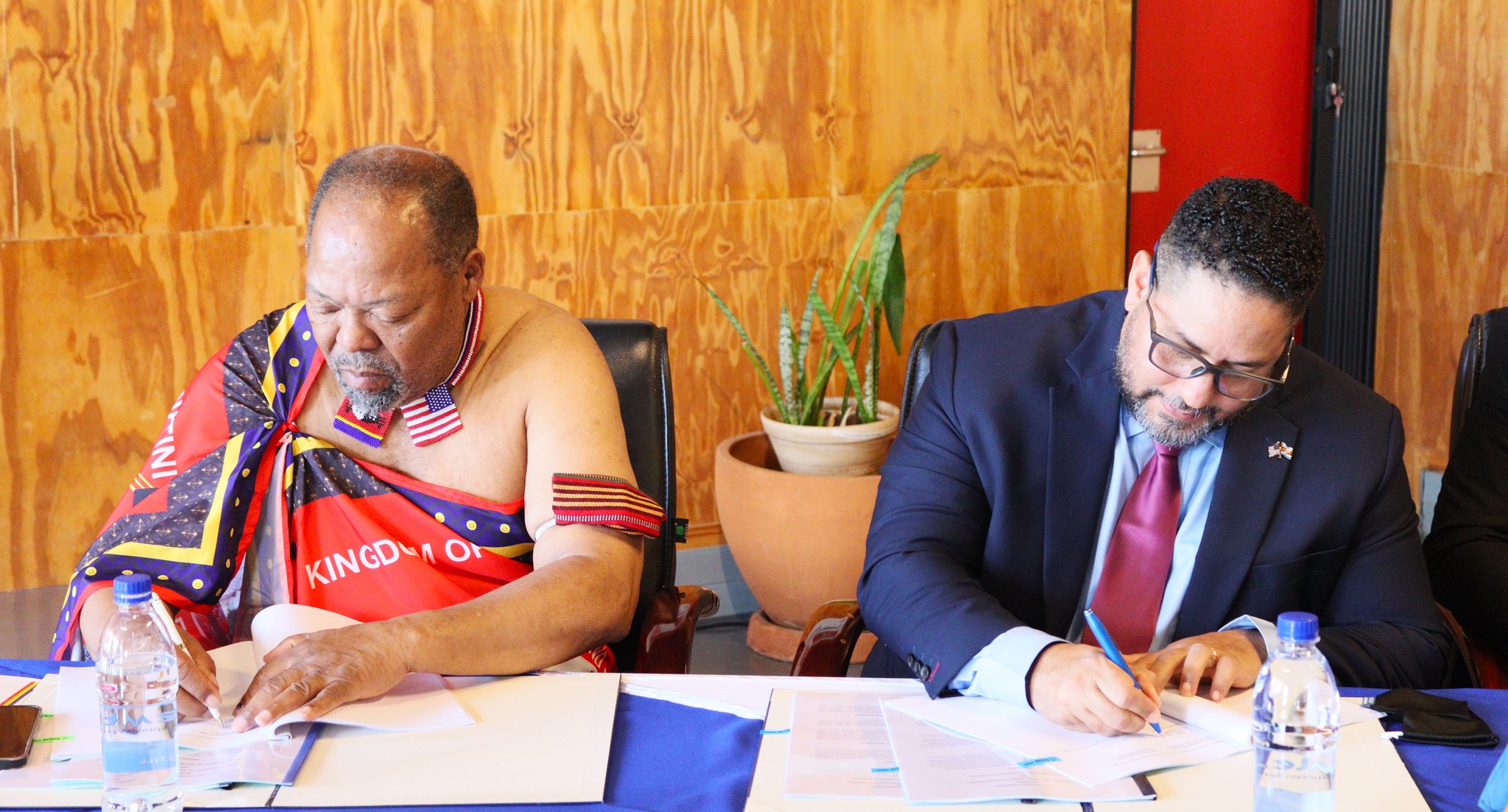
Eswatini and the United States of America have reinforced their long-standing cooperation in the health sector with the signing of a bilateral Memorandum of Understanding (MoU) that will see the US commit E4 billion (approximately US$242 million) to support Eswatini’s national health objectives from 2026 to 2030.
The signing ceremony, held in Mbabane on Friday, has been hailed as a significant moment for both nations, highlighting a shared commitment to strengthening public health systems and improving health outcomes.
Minister for Economic Planning and Development, Dr Tambo Gina, signed on behalf of the Government of Eswatini, while US Embassy Chargé d’Affaires, Mac Weinstock, signed for the United States Government.
This new agreement continues a decades-long partnership that has played a central role in shaping Eswatini’s response to HIV/AIDS, tuberculosis, and other major public health priorities.
Dr Gina noted that the collaboration formally began in 1968, shortly after independence, and has since evolved into one of the country’s most impactful development relationships.
“This partnership dates back to 1968 and has already brought significant improvements in the prevention and treatment of HIV and tuberculosis in our country. The new MoU will build on these achievements and advance our shared commitment to protect the health of our citizens,” Dr Gina said.
The funding under the MoU includes a blended contribution, with the Government of Eswatini adding US$37 million (over E600 million). This brings the total investment dedicated to the HIV response alone to more than E4 billion (US$242 million) over the five years.
The announcement comes as Eswatini celebrates major progress in combating HIV/AIDS, progress that has been widely recognised regionally and internationally.
According to the Ministry of Health, the country has reached a significant milestone: 215,000 people are currently on antiretroviral therapy (ART).
Additionally, new HIV infections have declined dramatically over the last decade, dropping by 75 per cent from 12,000 cases in 2011 to 4,000 in 2021.
Minister for Health Mduduzi Matsebula said the achievements are a direct result of sustained cooperation between Eswatini and the United States, particularly through the U.S.
President’s Emergency Plan for AIDS Relief (PEPFAR). He emphasised that the partnership has strengthened the national health system in several key areas, including the rollout of electronic medical records, decentralised laboratory services, and improved disease surveillance mechanisms.
“Over the past 20 years, collaboration with the US has made ART universally available, reduced new HIV infections drastically, and strengthened our national health systems through the introduction of electronic medical records, decentralised laboratories, and robust disease surveillance mechanisms,” Minister Matsebula said.
In addition, he said without the technical and financial support from the United States, it would have been far more challenging to reach universal ART coverage and achieve significant reductions in new infections.
US Embassy Chargé d’Affaires Mac Weinstock highlighted the scale of the United States’ contribution to Eswatini’s health sector over the past two decades.
“Over the last 20 years, the United States has invested more than E15 billion in Eswatini’s health sector. This investment has not only improved HIV outcomes but also reinforced our health system overall,” he stated.
Weinstock said the MoU builds on this foundation and ensures that the partnership continues to align with national priorities.
“This MoU is more than a document it reflects our mutual commitment to a healthier, more resilient future for both our nations,” he said.
The new MoU expands beyond HIV/AIDS and TB, incorporating broader health objectives tied to universal health coverage.
The E 4 billion allocation will support several key focus areas, including sustaining ART coverage for the 215,000 people currently on treatment, expanding HIV testing and linkage services, strengthening laboratory and diagnostic infrastructure, improving maternal and child health outcomes, and enhancing national disease surveillance capabilities.
Eswatini has implemented several innovative approaches in recent years to improve healthcare delivery, including decentralising laboratory services to broaden access for rural communities.
The continued integration of electronic medical records is also expected to improve patient tracking and overall system efficiency. Dr Gina said the new funding will help Eswatini prepare for future health emergencies, noting that the Covid-19 pandemic highlighted the importance of resilience and preparedness in national health systems.
“This assistance will help the country better respond to future health emergencies, such as outbreaks of communicable diseases or other public health crises,” he said.
He added that the partnership aligns with Eswatini’s long-term vision of ensuring equitable access to quality healthcare.
“We aim to achieve universal health coverage and ensure that no Eswatini citizen is left behind. The support from the United States under this MoU is crucial for achieving these goals,” he said.
The signing event was attended by representatives from government ministries, civil society organisations, and development agencies, reflecting broad support for the continuation of the partnership.
Minister Matsebula said the agreement marks a step towards greater national ownership of health programs, particularly in HIV prevention and treatment.
“The MoU recognises our national capacity to sustain the gains we have made and empowers us to fully lead the HIV prevention efforts,” he said.
He added that, beyond financial assistance, the partnership represents a transfer of technical knowledge and strengthened national capacity, key components for long-term sustainability.
Meanwhile, the bilateral relationship between Eswatini and the United States extends beyond health, covering areas such as education, economic development, and governance.
Matsebula in closing said the signing of this E4 billion MoU marks a new chapter in the 55-year partnership, reinforcing shared commitments to evidence-based interventions, improved health outcomes, and long-term cooperation.


