


 By
By 
By Delisa Magagula
The Kingdom of Eswatini’s E5.2 billion Strategic Oil Reserve project at Phuzamoya in Siphofaneni has received renewed impetus following His Majesty King Mswati III’s visit to the Türkmenbaşy Oil Processing Complex (TNGIZT) in Turkmenistan this week.
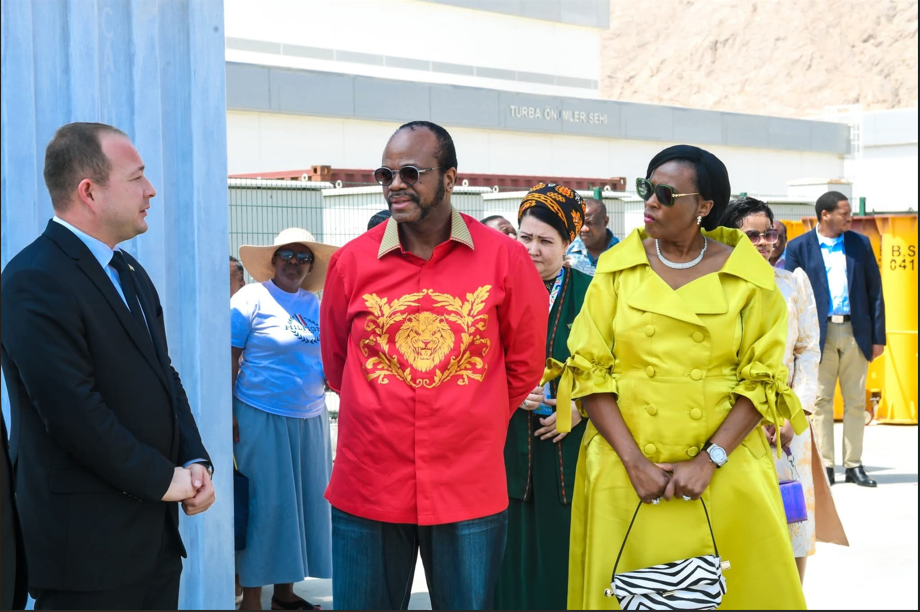
The King, accompanied by Inkhosikati LaMotsa, toured the complex and the Türkmenbaşy International Seaport on the sidelines of the Third United Nations Conference on Landlocked Developing Countries (LLDC3).
The visit came just a day after Eswatini and Turkmenistan formally established diplomatic relations, signalling a deepening of economic and technical cooperation between the two nations.
Speaking after the tour, officials from the Ministry of Natural Resources and Energy said the King’s engagements aimed to appraise and establish links with one of the world’s most advanced oil processing and port facilities as part of preparations for the construction of Eswatini’s own strategic reserve.
The Strategic Oil Reserve will store 83.6 million litres of fuel, a significant increase from the current national storage capacity of 3.6 million litres. This expansion is designed to provide at least 60 days of fuel security in the event of supply disruptions.
HRH Prince Lonkhokhela, the Minister of Natural Resources and Energy, told this publication that lessons drawn from Turkmenistan’s large-scale oil handling systems would be incorporated into Eswatini’s project design.
“The Turkmenbaşy complex is a benchmark in modern oil refining, storage, and distribution. Seeing how they integrate processing, transportation, and storage under a single operational framework gives us practical insight into efficiency and safety standards we can adapt for our facility at Phuzamoya,” he said.
The minister added that the King’s visit was not merely ceremonial but part of a deliberate strategy to secure international partnerships for technology transfer, skills training, and possible future supply agreements.
Parliament approved the E5.2 billion loan for the project on May 27, 2025, after a three-hour debate. The financing is being provided by the Republic of China (Taiwan) through its Export-Import Bank, under a fixed-cost contract arrangement. Taiwanese companies CTCI (design), OEEC (construction), and CECI (project management) will execute the project.
The loan will be repaid over 20 years, with a five-year grace period. The Eswatini National Petroleum Company (ENPC) will service the debt, backed by a government guarantee.
The initial engineering estimate for the reserve was E2.2 billion, but ENPC Chief Executive Officer Dumisani Motsa explained to legislators that the final E5.2 billion figure reflects a ready-for-construction design that incorporates additional safety, operational, and environmental measures.
These include nitrogen blanketing systems to reduce fire hazards, an expanded firefighting facility, weighbridges, a 4 million-litre ethanol blending unit, and training programmes for local staff.
“What Parliament approved is a facility that is not just functional but future-proof. It addresses operational risks and aligns with global safety and environmental standards,” Motsa said during the parliamentary session.
The banking sector has welcomed the project, viewing it as a driver of economic stability. Eswatini Bankers Association Chairperson Fikile Nkosi said the reserve would reduce the economy’s vulnerability to global fuel price shocks and supply chain disruptions.
“Fuel shortages and price volatility have a direct impact on business costs and consumer prices. Having a strategic reserve means greater predictability in operating costs for companies and fewer inflationary shocks for households. This is why the banking industry views the project as an essential pillar for macroeconomic stability,” Nkosi stated.
She added that the construction phase itself would inject liquidity into the economy through job creation, procurement of local goods and services, and infrastructure upgrades in the Lubombo region.
During the House of Assembly debate, MPs expressed mixed feelings over the cost escalation from the earlier E2.2 billion figure. Minister Lonkhokhela explained that the lower figure had been a preliminary engineer’s estimate and not based on a completed design.
Lobamba Lomdzala MP Marwick Khumalo, who chaired the debate session, said the facility’s scale justified the investment, noting that it would position Eswatini as an energy-secure state for decades.
“This is the largest loan we have ever approved as a nation, but the benefit outweighs the cost. Without energy security, our economy remains at the mercy of external supply shocks,” Khumalo said.
The facility will be built on a 30-hectare site in Phuzamoya and is expected to take three years to complete.
Meanwhile, energy experts point out that Eswatini currently relies heavily on fuel imports through South Africa, making it susceptible to disruptions from events such as strikes, port congestion, or geopolitical instability.
inister Lonkhokhela said the Phuzamoya reserve would eliminate the current hand-to-mouth supply model and give the government more flexibility in managing national fuel stocks.
“We will be able to buy and store fuel when prices are low, releasing it strategically to stabilise the market when prices rise. This is not just about security, it’s also about smart market management,” he explained.
The ethanol blending facility included in the project will allow for partial substitution of imported petroleum products with locally produced ethanol, supporting environmental targets and reducing the fuel import bill.
Worth mentioning is that Turkmenistan’s TNGIZT facility processes up to 10 million tonnes of crude oil annually and is integrated with the Türkmenbaşy International Seaport, enabling efficient import and export flows.
The King toured the plant’s refining units, control systems, and storage facilities, as well as the port’s handling equipment.
Government officials said the visit was an opportunity to explore whether Eswatini could adapt aspects of Turkmenistan’s vertically integrated oil logistics to its own scale and geography.
The King was also briefed on Turkmenistan’s use of advanced fire suppression systems, automated control technologies, and corrosion-resistant materials, all of which could be applied to Phuzamoya.
The LLDC3 conference, where the King’s visit took place, focuses on enhancing trade, transport, and energy resilience for landlocked developing countries.
The Phuzamoya project is aligned with these objectives, aiming to reduce Eswatini’s dependence on external infrastructure for fuel security.
The Ministry of Foreign Affairs confirmed that discussions with Turkmenistan included potential cooperation in oil and gas trade, training of Eswatini engineers, and port logistics management.
According to ENPC projections, construction will create between 200 and 800 local jobs, depending on the project phase.
Once operational, the facility will require skilled technicians, plant operators, and administrative staff, creating a permanent employment base in the Lubombo region.
Local businesses in transport, catering, security, and maintenance are expected to benefit from service contracts linked to the facility.
The project will also require upgrades to access roads and utilities in Phuzamoya, which could stimulate further regional development.
Minister Lonkhokhela confirmed that preliminary site works are expected to begin before the end of 2025, starting with ground preparation, access road improvements, and installation of basic utilities.
“We are on track to meet our project commencement target. The design is complete, the financing is secured, and procurement is ready to move. The next step is to mobilise on site,” he said.
The ministry has set a completion target of late 2028, subject to weather conditions and supply chain stability. Fikile Nkosi emphasised that the project’s long repayment horizon meant that the financial burden would be spread out without creating unsustainable fiscal pressure.
“The repayment structure, coupled with the economic returns from stability and job creation, makes this a manageable and prudent investment,” she said.
With the King’s Turkmenistan visit reinforcing technical and diplomatic channels, and with parliamentary and financial sector backing firmly in place, the Strategic Oil Reserve project now enters its implementation phase as one of the most ambitious infrastructure undertakings in Eswatini’s history.


