



 By
By 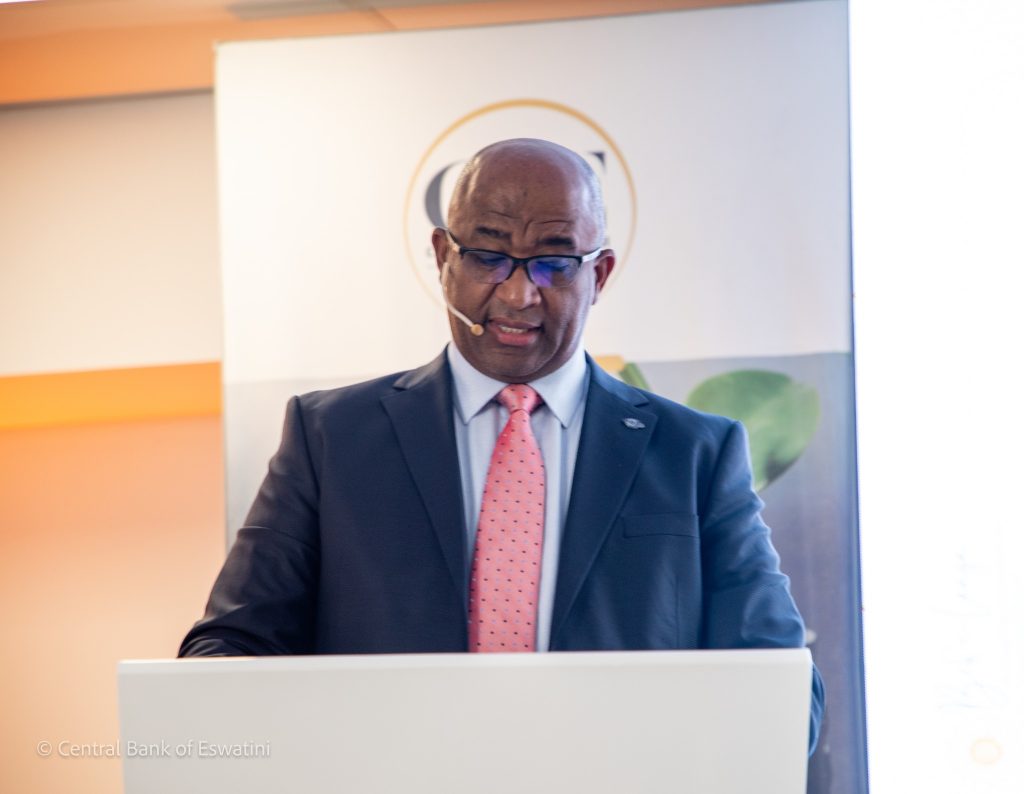
By Delisa Magagula
Delivering the Central Bank of Eswatini’s (CBE) 2025 Annual Monetary Policy Statement, Governor Dr. Phil Mnisi presented a cautiously optimistic picture of the country’s economic outlook, while warning of significant downside risks that could impede growth momentum over the medium term.
Speaking on the overall economic performance in the final quarter of 2024, Dr. Mnisi confirmed that Eswatini’s real gross domestic product (GDP) grew by 2.1 per cent year-on-year.
While this marked an expansion, it was a slowdown from the 2.8 per cent recorded in the previous quarter, largely due to poor performance in the tertiary sector.
“Growth was under pressure in Q4, primarily due to contractions in key service industries,” the Governor stated.
He noted that while the tertiary sector shrank by 0.2 percent year-on-year in Q4 down from a 2.9 percent increase in Q3 there were bright spots in the primary and secondary sectors that helped stabilize overall growth.
The primary sector rebounded sharply, registering a 5.0 per cent increase after contracting by 5.6 percent in the third quarter. Dr. Mnisi attributed this recovery to gains in animal production and mining and quarrying.
“Livestock output grew by 6.1 percent, driven by cattle slaughters and piggery operations, although poultry production saw a decline,” he said.
Additionally, coal production grew by 12.2 percent while quarried stone output increased by 27.0 percent year-on-year, boosted by infrastructure activity including the launch of the Mpakeni Dam project.
The secondary sector also performed strongly, posting a 6.2 percent growth in Q4, compared to 4.8 percent in Q3. This was largely due to surging manufacturing output, especially in food processing. “Food manufacturing expanded from 10.1 percent in Q3 to 19.7 percent in Q4, thanks to increased sugar production,” Dr. Mnisi said.
He also highlighted growth in meat processing, grain mill products, animal feed, textiles, paper products, and machinery manufacturing.
The construction sector showed modest signs of recovery, growing by 0.2 percent in Q4 after four consecutive quarters of contraction.
RELATED: We are coming for EswatiniMed – CBE Governor
The initiation of major infrastructure projects, particularly the Mpakeni Dam, was cited as a key stimulus for the sector. Likewise, the electricity supply subsector posted a 3.8 percent growth, ending a ten-quarter streak of negative results.
Despite these gains, the tertiary sector remained a source of concern. According to the Governor, several subsectors within services experienced negative growth.
The wholesale and retail trade shrank by 6.4 percent year-on-year in Q4, worsening from a 1.0 percent decline in Q3.
The financial services sector suffered a major blow, contracting by 15.5 percent following a 14.9 percent drop in the previous quarter.
Dr. Mnisi explained that global financial instability, in part triggered by the return of Donald Trump to the U.S. presidency and the ensuing policy uncertainty, severely impacted investment sentiment.
“Insurance and pension services saw a dramatic contraction of 39.8 percent, while asset managers experienced a 16.3 percent drop in offshore investment returns,” he said.
Other underperforming segments included real estate and business services, which grew by only 0.3 percent, and human health services, which declined by 4.5 percent.
However, the transport, storage and communication subsector offered a notable counterpoint to the generally subdued performance in services. This segment grew by a robust 26.3 percent year-on-year in Q4, up from 12.0 percent in Q3.
“Air transport, ICT services, and broadcasting led the charge in this impressive growth,” Dr. Mnisi said.
Tourism-related services also showed strong signs of recovery, growing by 12.9 percent year-on-year in Q4 after contracting by 2.1 percent in the previous quarter.
Increased activity from travel agencies, tour operators, and cultural events was credited for the rebound.
Despite the mixed sectoral performance, the Governor cautioned against assuming a smooth road ahead. He flagged several downside risks that could derail the recovery.
“On-going geopolitical tensions, particularly involving the United States and its major trade partners are likely to disrupt global supply chains and investor sentiment,” he said.
RELATED: CBE calls for familiarization with the new E50 commemorative note
He added that climate-induced variability, such as erratic rainfall patterns, poses risks to agricultural productivity and hydro-power generation two critical components of Eswatini’s economy.
Dr. Mnisi also raised concerns about fiscal policy constraints. “The projected decline in SACU receipts could limit the government’s ability to implement public investment projects in the 2025/26 fiscal year,” he warned.
This, combined with possible delays in private sector-led initiatives especially in the energy sector could further hamper economic progress.
Despite the challenges, Dr. Mnisi emphasized the CBE’s commitment to ensuring macroeconomic stability.
He reiterated the need for coordinated policy efforts between the monetary and fiscal authorities to safeguard the country’s growth trajectory.
“Strengthening investor confidence, diversifying export markets, and accelerating implementation of both public and private projects will be crucial in building a more resilient economy,” he concluded.
In sum, while Eswatini’s economy showed resilience in the face of global headwinds during the last quarter of 2024, significant risks loom over the horizon.
Policymakers will need to act decisively to sustain momentum and guard against potential shocks that could derail the fragile recovery.


